


If you’ve tried “positive thinking” or meditation for your anxiety or stress and they haven’t worked, it’s likely because your stress isn’t just in your head; it is trapped in your muscles. This is where somatic exercises come in. Unlike traditional workouts that push your body to the limit, somatic exercises are slow, gentle movements designed to “re-program” your brain and nervous system from the inside out.
By focusing on how your body feels rather than how it looks, these movements help release years of built-up tension. If you are struggling with anxiety at night and somatic exercises seem like a mystery, this guide will show you exactly how to use this body-first approach to find peace.
What Are Somatic Exercises?
The word “Soma” means “the body as perceived from within.” Somatic exercises are different from a gym workout or a standard stretch. In a normal gym class, you might move fast to burn calories. In a somatic yoga exercise session, you move as slowly as possible to notice where your body is “holding” onto stress.
Think of your nervous system like a smoke alarm. Sometimes, after a long period of stress, the alarm gets “stuck” in the ON position. You feel jumpy, irritated, or exhausted but unable to sleep. Somatic movements act as a manual override, sending a physical signal to your brain that says, “The danger is over. You can turn the alarm off now.”
Why Your Brain Needs Somatic Exercise for Healing
For a long time, doctors told us that to fix anxiety, we had to change our thoughts. But modern science in 2026 shows us that 80% of the nerves in our body send signals up to the brain, while only 20% send signals down.
This means it is much easier to calm the brain by moving the body than it is to calm the body by just “thinking happy thoughts.” This is the core principle of somatic therapy exercises. By releasing the physical grip of stress in your neck, shoulders, and hips, you naturally quiet the anxious thoughts in your mind.
The Role of the Vagus Nerve
Most somatic movements target the Vagus Nerve. This is a massive nerve that runs from your brain all the way to your abdomen. It controls your “Rest and Digest” system. When you perform somatic yoga exercises, you are essentially “massaging” this nerve, forcing your heart rate to slow down and your muscles to soften.
Solving Anxiety at Night and Somatic Exercises for Sleep
One of the most common reasons people search for a somatic therapy exercises PDF is because they cannot sleep. This is often called “tired but wired.”
When you lie on your bed at night, your brain finally has a moment of silence. Unfortunately, your body uses this silence to “dump” all the stress chemicals (like cortisol) it collected during the day. This creates a surge of anxiety at night.
Doing somatic exercises right before bed helps “digest” these stress chemicals. Instead of the energy staying trapped in your legs or chest (causing tossing and turning), it is released through gentle movement, allowing for a deep, natural sleep.
5 Life-Changing Somatic Exercises to Try Today
You can do these in your bed or on a soft rug. No equipment is needed.
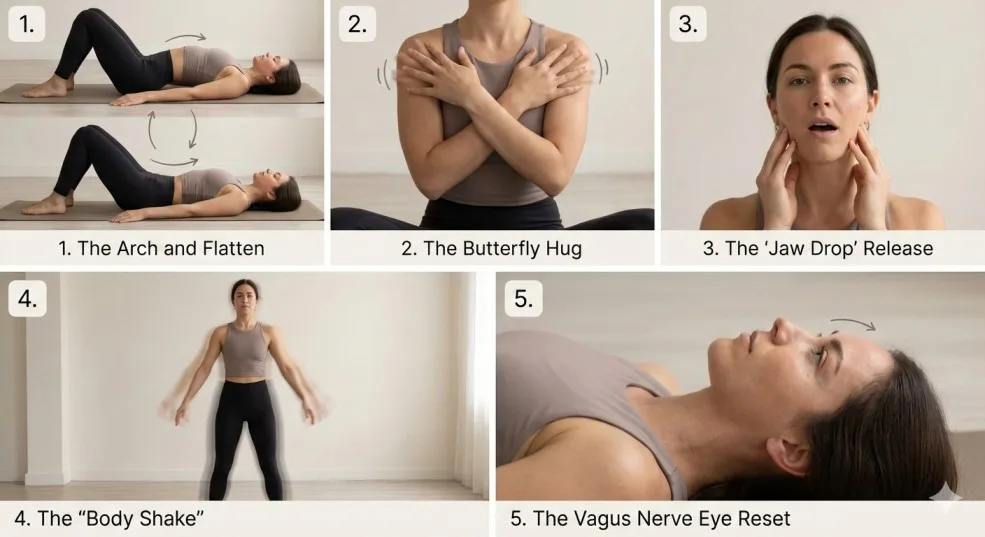
1. The Arch and Flatten (Somatic Yoga Style)
This is the “gold standard” for releasing lower back pain and stomach tension.
- How to do it: Lie on your back with your knees bent and feet flat on the floor.
- The Move: As you inhale, gently arch your lower back so a little “tunnel” forms under you. As you exhale, slowly flatten your back against the floor and gently tilt your hips toward your chin.
- The Secret: The slower you go, the better it works. Try to feel every single bone in your spine moving.
- Benefit: This releases the “Green Light Reflex,” which is the tension we hold when we are constantly “on the go.”
2. The Butterfly Hug for Instant Calm
This is a favorite in somatic therapy exercises because it works in under two minutes.
- How to do it: Cross your arms over your chest, hooking your thumbs together to form a “butterfly” shape with your hands. Your fingers should rest just below your collarbones.
- The Move: Alternately tap your left hand and then your right hand on your chest. Breathe deeply and slowly.
- Benefit: This is called “bilateral stimulation.” It helps the left and right sides of your brain process stress and lowers your heart rate almost instantly.
3. The “Jaw Drop” Release
We hold an incredible amount of anger and “unspoken stress” in our jaws.
- How to do it: Sit comfortably. Place your fingertips on your jaw joint (just in front of your ears).
- The Move: Slowly let your jaw hang open as wide as is comfortable. Move your jaw very slightly from side to side. Then, slowly—almost painfully slowly—close it.
- Benefit: This relaxes the cranial nerves associated with the “Fight or Flight” response.
4. The “Body Shake” (The Stress Release)
If you feel “jittery” or have anxiety at night, this is the best move for you.
- How to do it: Stand up. Start by gently bouncing your heels off the floor.
- The Move: Let the bounce turn into a shake. Shake your hands, then your arms, then your whole body. Do this for 1–2 minutes.
- Benefit: This mimics how animals in the wild release trauma. It literally “shakes” the adrenaline out of your system so it doesn’t turn into a panic attack.
5. The Vagus Nerve Eye Reset
- How to do it: Lie on your back with your hands interlaced behind your head.
- The Move: Keep your head still, looking straight up. Now, move just your eyes to the far right. Hold them there until you feel a sudden need to yawn, sigh, or swallow. Repeat on the left side.
- Benefit: This move physically signals the brain stem to switch into a state of safety.
READ ALSO: Vagus Nerve Stimulation Explained: How To Relieve Stress, Heal, and Reset Your Nervous System
Creating Your Own “Somatic Exercises” Routine
If you want to keep these moves handy, you can create a simple pdf somatic exercises cheat sheet on your phone. Here is a 10-minute daily routine you can follow:
| Time | Exercise | Why? |
| 0-2 mins | The Body Shake | To release the day’s “stored” stress energy. |
| 2-5 mins | Arch and Flatten | To relax the spine and prepare for rest. |
| 5-7 mins | Jaw Drop | To stop clenching and facial tension. |
| 7-10 mins | Eye Reset | To signal the brain that it is safe to sleep. |
By following this somatic therapy exercise plan, you give your body a clear “off-switch” every evening.
Common Questions About Somatic Exercises
Do I need a “Somatic therapy exercises PDF” to get started?
While having a guide helps, the most important part of somatic work is listening to your body. If a movement feels good, keep doing it. If it feels forced, slow down. The goal is comfort, not “the burn.”
Is somatic exercise the same as regular Yoga?
Not quite. Somatic yoga exercises are much smaller and slower. In regular yoga, you might try to reach your toes. In somatics, you only move as far as you can while staying completely relaxed.
How long until I see results?
Most people feel a “lightness” or a “softening” after their very first session. However, to stop chronic anxiety at night, somatic exercises need to be done consistently for about two weeks to truly “rewire” the nervous system.
References & Scientific Sources
- Hanna, T. (1988). “Somatics: Reawakening The Mind’s Control Of Movement, Flexibility, And Health.” (The founding text of somatic movement).
- Porges, S. W. (2017). “The Pocket Guide to the Polyvagal Theory: The Transformative Power of Feeling Safe.”
- Payne, P., et al. (2015). “Somatic experiencing: using interoception and proprioception as core elements of trauma therapy.” Frontiers in Psychology.
- Levine, P. A. (1997). “Waking the Tiger: Healing Trauma.” (Explains why “shaking” and somatic moves are essential for nervous system health).











Leave a Reply