

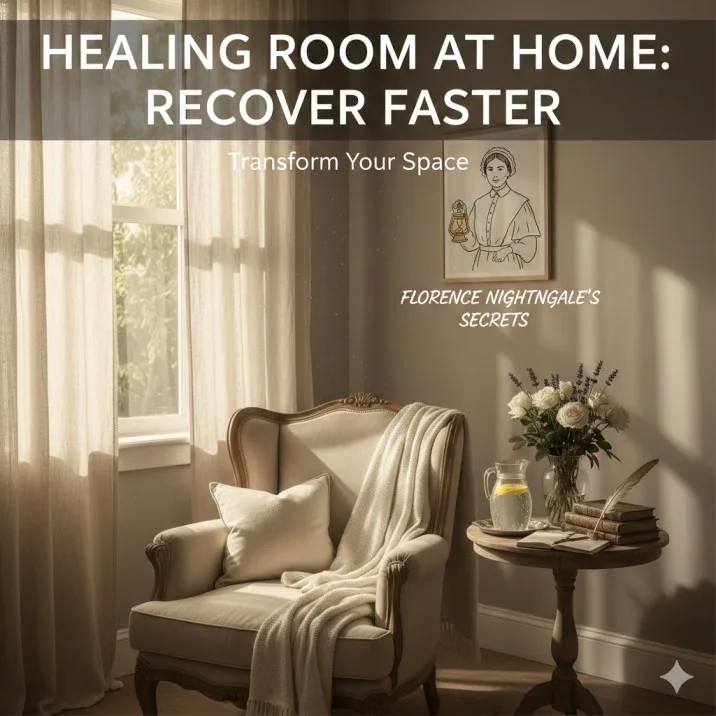
If you are currently bedridden or looking for healing room at home ideas, you can use these 150-year-old “Nursing Secrets” to create a natural bedroom healing environment that helps you bounce back faster.
When you’re feeling under the weather, your first instinct is likely to reach for a bottle of pills. Whether it’s cough syrup, pain relievers, or a cocktail of vitamins, we tend to focus entirely on what we put into our bodies. But have you ever noticed that even with the best medicine, you can still feel miserable if your bedroom is stuffy, dark, and cluttered?
In the mid-1800s, Florence Nightingale changed the world of medicine by proving that medicine alone isn’t what heals us. As the founder of modern nursing, her “Environmental Theory” proposed a revolutionary idea: Nature is the ultimate healer. Her job, and yours when you’re sick, is to put the body in the best possible condition for Nature to do its work.
What Are The Healing Room At Home Ideas?
These are the things you can do at home, when you fall sick or have someone who is, to ensure the environment supports a quick recovery from the illness. Coined from Florence Nightingale, below are the ideas you can create or build for better healing, even before reaching out to that bottle of pills.
Ensure Fresh Ventilation
Nightingale’s very first requirement for any patient was fresh air. She famously wrote in her 1859 book, Notes on Nursing, that the “very first canon” of nursing is to keep the air the patient breathes as pure as the external air, without chilling them.
How to Set Up a Sick Room for Better Air:
In modern homes, we often seal windows to save energy. However, when you’re sick, you are shedding pathogens and breathing out stale carbon dioxide.
- The “Air Flush”: Open a window in a nearby room and your bedroom window for 10 minutes to create a cross-breeze.
- The Warmth Buffer: Nightingale was strict about warmth. If you open a window, ensure you are wrapped in a warm blanket or using a hot water bottle. The air should be moving, but your skin should stay cozy.
- Ditch the Scents: Avoid “air fresheners” or heavy perfumes. Nightingale warned that these just mask “sick air” rather than cleaning it.
Let the Light In (Circadian Healing)
Nightingale observed that sick people naturally turn their faces toward the light, much like a plant turns toward the sun. She believed that light, specifically direct sunlight, was essential for recovery.
Modern science now confirms the Florence Nightingale environmental theory application regarding light. Sunlight regulates our circadian rhythm, our internal biological clock. This clock tells our immune system when to go into “attack mode” and when to rest. A dark, gloomy room can increase pain perception and lead to the mental fatigue often called “brain fog.”
Tips for a Natural Bedroom Healing Environment:
- Open the Curtains: Unless you are suffering from a migraine, keep the blinds wide open during the day.
- Position for a View: If possible, move your bed so you can see out the window. Nightingale argued that seeing the sky or a bit of greenery helps the mind stay positive, which chemically assists the body in healing.
- Avoid “Blue Light” at Night: Nightingale would have hated our modern screens. Dim all artificial lights as the sun sets to allow your brain to produce melatonin for deep, restorative sleep.
Creating a Biophilic Bedroom for Wellness
A major trend in 2026 is biophilic design, the practice of bringing nature indoors. Nightingale called this “Variety.” She noticed that patients who had something beautiful to look at, a bouquet of flowers, a colorful painting, or a changing view, recovered significantly faster than those staring at a blank wall.
Why Variety Matters:
The brain needs stimulation to stay out of a “depression loop” during long illnesses.
- The Single Plant: Place one vibrant, green plant (like a Snake Plant or Peace Lily) within your line of sight. This acts as a living “anchor” for your focus.
- Rotating Art: If you are stuck in bed for more than three days, have someone change the art on your wall or move a decorative object into your view. This small change “wakes up” the brain’s recovery centers.
Stay Cleaned: Avoid a dirty environment/room
To Nightingale, dirt was the enemy. But she didn’t just mean washing your hands. She meant the organic matter that we “shed” when we are ill. When you have a fever, you are sweating out toxins; when you cough, you are releasing microbes. If these stay in your sheets, you are essentially living in a “germ trap.”
How to Maintain Your Healing Room:
- The 24-Hour Pillowcase Swap: You don’t need to change the whole bed every day, but swapping your pillowcase daily prevents you from breathing back in the bacteria or viruses you coughed out the night before.
- Damp Dusting: Don’t use a dry duster (which just kicks dust into the air). Use a damp cloth to wipe down the surfaces near your bed (like your nightstand and phone) twice a day.
- Personal Hygiene: Even a simple sponge bath with warm water can open your pores and refresh your spirit, making you feel “human” again.

Quietness: The “Forgotten Medicine”
Nightingale wrote extensively about “unnecessary noise.” She wasn’t worried about the distant sound of a bird or a breeze; she hated avoidable noises, like a door slamming, a floorboard creaking, or people whispering outside the room.
The Science of “Startle”:
Sudden noises “startle” the nervous system. When you are startled, your body produces cortisol (the stress hormone). Cortisol actively suppresses the immune system, meaning every time you are woken up by a loud TV or a shouting neighbor, your recovery slows down.
How to ensure a quiet environment when sick:
- Phone on “Do Not Disturb”: Constant pings from notifications keep your brain in a state of high alert.
- No Whispering: Nightingale noted that whispering is more stressful for a patient than a low, steady voice. Whispering makes the sick person strain to hear, causing anxiety.
- White Noise: If your environment is naturally loud, use a fan or a white noise machine to create a steady “curtain” of sound.
Eating Good Food in a “little and often” approach
When we are sick, our appetite often disappears. However, your immune system needs fuel to fight. Nightingale’s advice was to avoid giving a sick person a giant plate of food, which can feel overwhelming and nauseating. Instead, use the “Little and Often” approach.
Nutrition Tips for the Sick Room:
- Small Portions: Give 2–3 bites of nutrient-dense food every hour rather than three big meals.
- Clear Fluids First: Use bone broth or electrolyte-rich drinks. Nightingale’s famous “beef tea” was the 19th-century version of modern collagen-rich broths.
- The “Presentation” Rule: Even if it’s just a bowl of grapes, make it look nice. Nightingale believed that “appetite of the eye” was the first step toward actual digestion.
READ ALSO: 12 Best Foods to Boost Immunity Naturally & Strengthen Your Defence
Summary of Healing Room at Home Ideas
A “Healing Room” uses environmental factors (Air, Light, Quiet, Cleanliness) to speed up recovery. Based on Florence Nightingale’s Environmental Theory, which posits that nature heals, and nursing provides the best conditions for that healing.
What to do: Prioritize pure air (ventilation) and natural light to regulate the body’s circadian rhythm. Incorporate biophilic bedroom for wellness ideas, such as indoor plants and landscape views, to reduce stress and “brain fog.” Avoid whispering and sudden sounds to prevent cortisol spikes that suppress the immune system.
FAQ on Setting Up a Healing Room at Home
Q: Can I use these healing room ideas for chronic illness or just temporary colds?
A: These principles apply to both! A natural bedroom healing environment is especially helpful for chronic fatigue or long-term recovery, as it prevents the “stagnation” that often slows down progress.
Q: What is the most important Nightingale secret for a small apartment?
A: Ventilation. In a small space, air becomes “stale” (high in CO2) very quickly. The “Air Flush” is your most powerful tool.
Q: Is “Biophilic Design” really scientific?
A: Yes. Modern research in environmental psychology shows that seeing nature lowers blood pressure and heart rate within minutes. It’s a core part of healing room at home ideas in 2026.
Wrapping Up: Healing Room At Home Ideas
Florence Nightingale once said, “Nature alone cures… and what nursing has to do is to put the patient in the best condition for nature to act upon him.”
By focusing on your biophilic bedroom for wellness and following the Florence Nightingale environmental theory application, you aren’t just waiting to get better. You are actively building a sanctuary where your body has the energy, light, and air it needs to win the fight against illness.
References
- Nightingale, F. (1859). Notes on Nursing: What It Is, and What It Is Not.
- Selanders, L. C. (2010). “The Power of Environmental Theory.” Journal of Holistic Nursing
- Huisman, E. R., et al. (2012). “Healing environment: A review of the impact of physical environmental factors on users.“
- Choi, J. H., et al. (2025). “Impact of natural light and biophilic elements on home-based recovery.” Journal of Environmental Psychology













Leave a Reply