

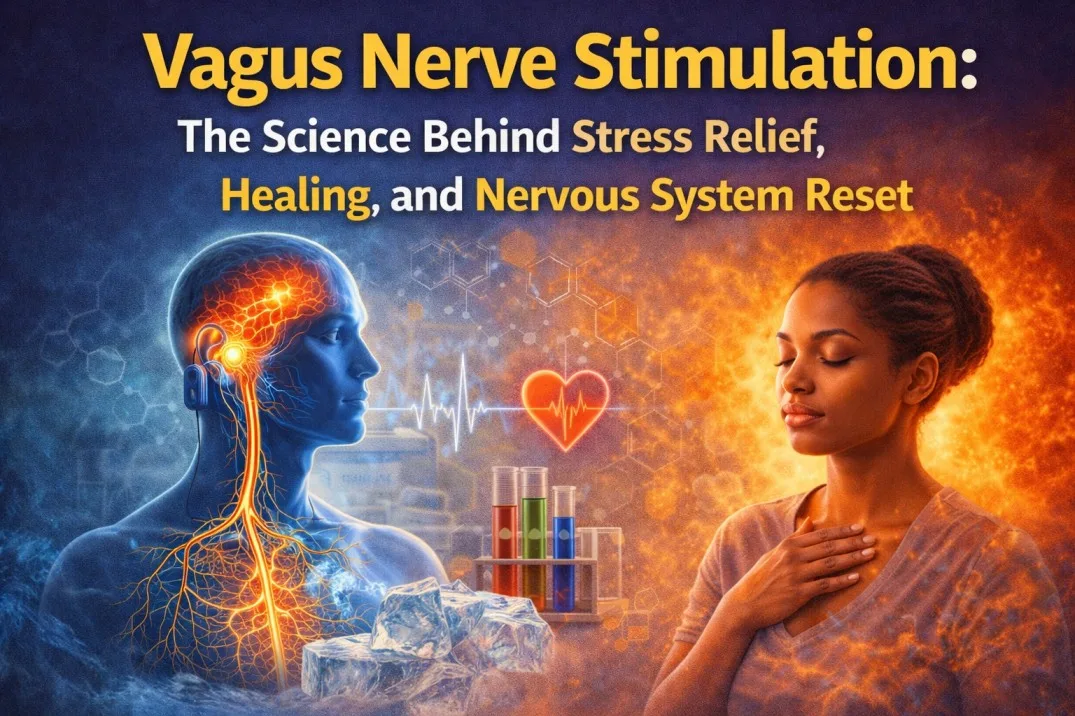
As interest in nervous system regulation, somatic healing, and stress resilience reaches record highs, Vagus Nerve Stimulation (VNS) has emerged as a central focus in both clinical medicine and self-care. From FDA-approved medical implants to simple breathing and cold-exposure techniques, stimulating this nerve is proving to be one of the most effective ways to influence anxiety, depression, inflammation, and overall resilience.
For decades, the nervous system was treated as a one-way command center: the brain issued orders, and the body simply reacted. But research emerging in 2024 and 2025 has fundamentally changed that view. We now know the body is constantly sending information back to the brain, and the primary communication line is the Vagus Nerve.
This guide explains what the vagus nerve is, how stimulation works, what the science actually shows, and how you can safely support vagal tone without hype, mysticism, or misinformation.
What is the Vagus Nerve?
The word “Vagus” is Latin for “wandering,” which is a perfect description for this nerve. It is the longest cranial nerve in the body, starting at the brainstem and wandering down through the neck, heart, and lungs, eventually branching out into the gut and digestive organs.
It is the primary commander of your Parasympathetic Nervous System (PNS), the “Rest and Digest” mode. When the Vagus Nerve is active, your heart rate slows, your blood pressure drops, and your body focuses on repair and digestion. When it is weak (low “vagal tone”), your body stays stuck in “Fight or Flight” mode, leading to chronic stress, poor sleep, and systemic inflammation.
What does vagus nerve stimulation do?
Vagus nerve stimulation (VNS) activates parasympathetic pathways that slow heart rate, lower stress hormones, reduce inflammation, and promote emotional regulation. It works by increasing “vagal tone,” a marker associated with better resilience to stress, improved digestion, and balanced immune response.

How Vagus Nerve Stimulation Affects the Brain
The vagus nerve is not just a cable; it is a two-way communication highway. Roughly 80% of its fibers are sensory, meaning they carry information from the body to the brain rather than the other way around.
When stimulated, the vagus nerve influences:
- Brainstem activity
- Neurotransmitter balance
- Emotional regulation
- Neuroplasticity
This explains why vagal activation can rapidly shift the body from “fight or flight” into “rest and repair.”
Does vagus nerve stimulation work for depression?
Yes. Clinical trials show that vagus nerve stimulation can significantly improve symptoms in people with treatment-resistant depression (TRD). A large multicenter trial published in late 2024 reported meaningful improvements in mood, quality of life, and daily functioning in patients who had not responded to conventional treatments.
How to perform Vagus Nerve Stimulation at Home
While medical-grade VNS devices are implanted surgically for epilepsy or depression, you can “tone” your Vagus Nerve at home using physiological hacks. These techniques leverage the nerve’s proximity to the surface of the skin and its connection to the breath.
1) Cold Exposure
Splashing ice-cold water on your face or taking a cold plunge triggers the “mammalian dive reflex.” This causes an immediate increase in vagal activity, forcing the heart rate to slow down and the nervous system to shift from “panic” to “calm.”
2) Diaphragmatic Breathing
Because the Vagus Nerve passes through the diaphragm, deep “belly breathing” physically massages the nerve. The key is the extended exhale. When your exhale is longer than your inhale (e.g., inhale for 4, exhale for 8), you send a signal directly to the brainstem that the environment is safe.
3) Vocal Vibrations: Humming and Chanting
The Vagus Nerve passes right by the vocal cords. Research shows that the vibrations created by humming, singing, or gargling water can physically stimulate the nerve fibers in the throat, triggering a relaxation response.
Vagus Nerve and the Gut-Brain Axis
Have you ever had “butterflies” in your stomach or a “gut feeling”? That is your Vagus Nerve talking. Because it heavily innervates the gastrointestinal tract, it is the primary link in the gut-brain axis.
A healthy Vagus Nerve ensures:
- Gastric Motility: Food moves through the digestive tract at the right speed.
- Microbiome Health: The nerve helps maintain a balanced environment for “good” bacteria.
- Hunger Regulation: It carries signals of fullness (satiety) to the brain, helping with weight management.
READ ALSO: Are Energy Drinks Good for Your Body? Everything You Need To Know
The 2026 Wearable Revolution: Non-Invasive VNS (taVNS)
The newest frontier in health technology is taVNS (Transcutaneous Auricular Vagus Nerve Stimulation). These are non-invasive devices that deliver tiny electrical pulses to the auricular branch of the Vagus Nerve located in the ear.
Clinical studies in 2025 are exploring these wearable devices for:
- Stroke Rehabilitation: Helping the brain “re-wire” (neuroplasticity) to regain limb movement.
- Migraine Relief: Reducing the frequency and intensity of cluster headaches.
- Performance Anxiety: Used by athletes and performers to stay in a “flow state” under pressure.
FAQs about Vagus Nerve Stimulation
Q: How do I know if my Vagus Nerve is “weak”?
A: Common signs of low “vagal tone” include chronic digestive issues (IBS), difficulty “winding down” at night, high resting heart rate, and feeling easily overwhelmed by small stressors.
Q: Can I over-stimulate the Vagus Nerve?
A: In medical settings, improper settings on a VNS device can cause hoarseness or coughing. However, with natural methods like breathing or cold water, it is nearly impossible to “over-stimulate” it; your body has natural buffers to keep you in balance.
Q: How long does it take to improve vagal tone?
A: Exercises like deep breathing or cold splashes provide immediate relief from acute stress (within 2–5 minutes). However, long-term changes in “vagal tone”, meaning a naturally lower resting heart rate and better digestion, usually take 2 to 4 weeks of daily practice.
Q: Does humming actually work for Vagus Nerve Stimulation?
A: Yes. Science shows that “Vagal tone” increases during humming because it activates the laryngeal muscles, which are directly connected to the Vagus Nerve.
Q: What is taVNS?
taVNS is a non-invasive form of vagus nerve stimulation that delivers mild electrical pulses to the auricular branch of the nerve in the ear. In 2025, research is exploring its use in stroke recovery, migraine prevention, anxiety regulation, and performance optimization.
Conclusion: Vagus Nerve Stimulation
The future of stress management is not about suppressing symptoms; it’s about regaining communication with your nervous system. Vagus nerve stimulation represents a shift from force-based health strategies to signal-based regulation.
When you learn how to engage this system, stress stops feeling like an uncontrollable force and starts behaving like something you can influence moment by moment.
References for further reading
- Conway, C. R., et al. (Dec 2024/Jan 2025). “Vagus Nerve Stimulation in Treatment-Resistant Depression: A One-Year, Randomized, Sham-Controlled Trial.” Brain Stimulation Journal.
- UCLA Health (2025). “Vagus Nerve Stimulation (VNS): Clinical Applications and Home Hacks.” UCLA Medical Research.
- Chen, Z., & Liu, K. (Feb 2025). “Mechanism and Applications of Vagus Nerve Stimulation.” Current Issues in Molecular Biology.
- Gargus, et al. (2025). “Vagus nerve stimulation for the treatment of neurodevelopmental disorders: A focus on neuroinflammation.” PubMed / Frontiers in Neuroscience.












Leave a Reply