

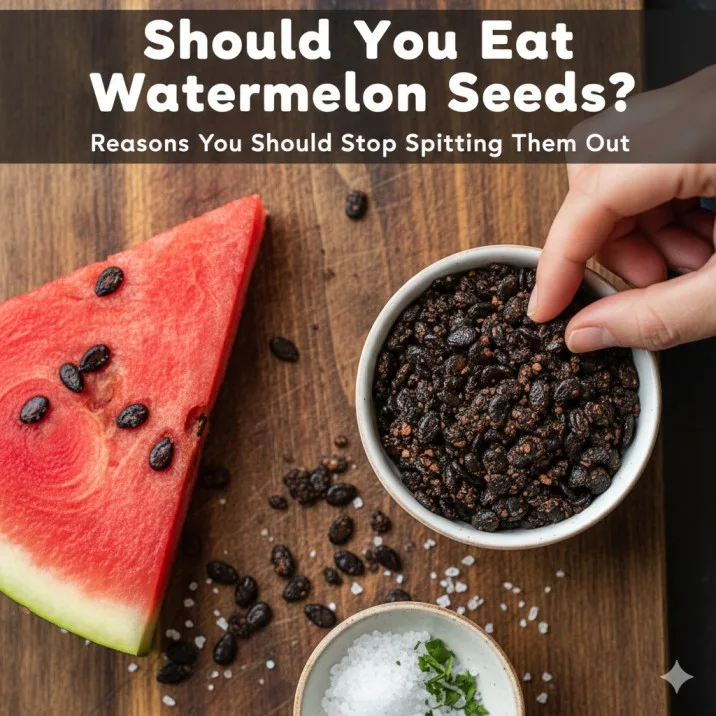
You’re probably wondering: should I eat watermelon seeds, right?
We’ve all been there. You’re face-deep in a cold, dripping wedge of watermelon on an afternoon, and suddenly, crunch. You’ve hit a black seed. If you grew up with the same playground legends I did, your first instinct might be a flash of mild panic. Is a giant melon about to take root in my stomach?
Spoiler alert: No. In fact, your stomach acid is far more likely to turn that seed into fuel than a fruit garden.
For decades, we’ve treated watermelon seeds like the “annoying relative” of the fruit world—something to be picked out, spat away, or avoided entirely by buying seedless varieties. But it turns out we’ve been throwing away the most nutritious part of the melon.
Let’s dive into why these little black specks are actually nature’s hidden “super-pills” and how you can actually make them taste good.
Are Watermelon Seeds Safe to Eat?
Let’s get the big question out of the way first: Yes, watermelon seeds are 100% edible.
Whether you swallow the soft, white “immature” seeds or the hard, black “mature” seeds, you are perfectly safe. Your digestive system handles them just like any other fiber-rich seed (think flax or chia). They won’t sprout in your belly, and they won’t cause a blockage unless you’re eating buckets of them raw without chewing, which, frankly, sounds like a chore anyway.
READ ALSO: The Health Risks of Instant Noodles: What It Does To Your Heart, Brain, And Metabolism
The Myth of the “Stomach Melon”
The reason we think they’re “bad” is mostly cultural. In the U.S. and much of Europe, we’ve been conditioned to prefer “seedless” produce for convenience. However, in many cultures across Africa, the Middle East, and Asia, watermelon seeds are harvested, dried, and roasted as a staple snack.
The Nutritional Powerhouse You’re Throwing Away
If you looked at a watermelon seed under a microscope (metaphorically speaking), you’d find a tiny treasure chest. Ounce for ounce, these seeds are more nutrient-dense than the melon’s red flesh.
1. A Surprising Protein Boost
Did you know that watermelon seeds are roughly 30% protein? To put that in perspective, a handful of roasted watermelon seeds (about an ounce) contains roughly 8 grams of protein. That’s more than a large egg!
2. Magnesium: The “Chill Out” Mineral
Most of us are magnesium-deficient without even knowing it. Magnesium is crucial for heart health, nerve function, and keeping your blood pressure in check. According to the National Institutes of Health (NIH), magnesium is involved in over 300 biochemical reactions in the body. A small serving of these seeds provides about 20% of your daily needs.
3. The “Good” Fats
Watermelon seeds are rich in monounsaturated and polyunsaturated fatty acids. These are the “healthy fats” that help lower bad cholesterol and keep your brain happy. According to a study published in the International Journal of Agronomy and Agricultural Research, these seeds are an excellent source of omega-6 fatty acids.
4. Zinc for Your Immune System
If you’re trying to dodge the seasonal sniffles, watermelon seeds have your back. They are a solid source of zinc, which is vital for your immune system, cell growth, and even your sense of taste and smell.
Raw vs. Roasted Watermelon Seeds: Which is Better?
While you can eat them raw straight out of the fruit, you probably won’t enjoy them much. Raw seeds are slippery and have a very tough outer shell, making it hard for your body to access the nutrients inside.
To get the most bang for your buck, you want to sprout or roast them.
- Sprouting: This breaks down the compounds that make seeds hard to digest (like phytic acid).
- Roasting: This makes the outer shell crispy and gives the “nut” inside a delicious, savoury flavour similar to a sunflower seed or a light pumpkin seed.
How to Roast Watermelon Seeds Safely
Ready to stop wasting? Next time you slice up a melon, save the seeds in a bowl. Here is the easiest way to turn them into a gourmet snack:
- Rinse and Dry: Wash the slime off the seeds and pat them bone-dry with a paper towel. (Wet seeds = soggy seeds).
- Season: Toss them in a bowl with a teaspoon of olive oil and a pinch of salt.
- Pro Tip: Try “Everything Bagel” seasoning or a mix of lime juice and chilli powder for a kick.
- Roast: Spread them on a baking sheet and bake at 325°F (160°C) for 15–20 minutes.
- Cool: Let them get crunchy as they cool down.
Comparison: Watermelon Seeds vs. Other Snacks
How do these stack up against the “big players” in the snack aisle?
| Nutrient (per 1oz) | Watermelon Seeds (Roasted) | Almonds | Potato Chips |
| Protein | ~8g | ~6g | ~2g |
| Magnesium | ~140mg | ~80mg | ~8mg |
| Healthy Fats | High | High | Low (mostly saturated) |
| Fiber | Moderate | High | Low |
The Side Effects of Eating Watermelon Seeds
Is there any reason not to eat them? Not really, but use common sense.
- Fiber Overload: Because they are very high in fiber, eating two cups of them in one sitting might lead to some “digestive speediness” (if you catch my drift).
- Salt Content: If you buy pre-packaged roasted seeds, watch the sodium. They can be salt-bombs if you aren’t careful.
The Verdict: Don’t Spit, Just Snack
The next time someone tells you that eating watermelon seeds is a bad idea, you can kindly inform them that they are missing out on a protein-packed, magnesium-rich superfood that’s literally free with their fruit purchase.
By eating the seeds, you’re reducing food waste and giving your body a hit of minerals that are hard to find in a standard diet. It’s a win for the planet and a win for your heart.
References & Further Reading
- Nutritional values and mineral content: USDA FoodData Central
- Magnesium benefits: National Institutes of Health (NIH) Office of Dietary Supplements
- Seed Composition Study: Journal of Pharmacognosy and Phytochemistry – Research on Citrullus lanatus (Watermelon) seed oil and nutrition.







Leave a Reply